
Home › Forums › Prosthetic dentistry › Removable prosthodontics › Stabilizing Partial Dentures Using Small-Diameter Implants
Welcome Dear Guest
To create a new topic please register on the forums. For help contact : discussdentistry@hotmail.com
- This topic has 2 replies, 2 voices, and was last updated 24/09/2012 at 5:57 pm by
Drsumitra.

-
AuthorPosts
-
24/09/2012 at 5:55 pm #15942
 drmithila
OfflineRegistered On: 14/05/2011Topics: 242Replies: 579Has thanked: 0 timesBeen thanked: 0 times
drmithila
OfflineRegistered On: 14/05/2011Topics: 242Replies: 579Has thanked: 0 timesBeen thanked: 0 timesSmall-Diameter Implants for Lower Partial Dentures
Small-diameter implants can also be a very useful option for lower partial dentures, as illustrated in Figures 11 to 13. This is a situation that is often encountered in dental offices. As seen, this patient had retained teeth Nos. 27, 28, and 31. Her existing partial denture had clasps placed around these teeth for stabilization. However, there were no teeth on the opposite side for the denture to be anchored to (Kennedy classification 2).
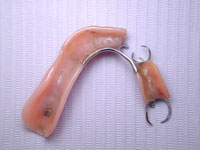
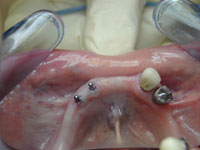
Figure 11. In this case, an existing partial denture used clasps around Teeth Nos. 27, 28, and 31 for retention, but there was no stabilization of the opposite side.
Figure 12. Two small-diameter implants were placed in the positions of Teeth Nos. 21 and 22.
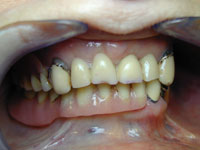
Figure 13. The patient’s partial denture was then adapted to fit the small-diameter implants.
Two small-diameter implants were placed in the positions of Nos. 21 and 22, and the patient’s partial denture was adapted to fit the metal housings. After the treatment was completed in less than an hour, the patient was much more satisfied with the increased retention of her partial denture.
CLOSING COMMENTS
The stability level of a denture can have significant effects on a patient’s quality of life. For example, when loose dentures impede a proper diet, the patient’s systemic health can be negatively impacted. It is vital for dentists to have discussions with edentulous and partially edentulous patients about their current satisfaction level with their existing (partial/full) denture(s). Then, the patient should be presented with any possible options to increase retention and stability to improve their satisfaction level.
For patients who do opt to pursue removable prosthetic implant treatment, small-diameter implants can very often be a more affordable and satisfying solution than some standard-diameter implant treatments. Studies have shown the survival rate of small-diameter implants to ranges from 91.2% to 96.3%, comparable to the success of traditional implants. The added benefits of small-diameter implants—their minimal invasiveness, lower cost, compatibility with areas where there is less bone volume, ability to be immediately loaded, reduced chair time for placement, and overall treatment length—make them a viable treatment option for many patients.24/09/2012 at 5:57 pm #15943Drsumitra
OfflineRegistered On: 06/10/2011Topics: 238Replies: 542Has thanked: 0 timesBeen thanked: 0 timesSmall-Diameter Implant Insurance CodingGaining in rapid popularity are these so-called “mini-implants.” They are sometimes referred to as “small” or “narrow diameter,” depending on the precise dimensions as well as specific manufacturer. The more traditional versions had a simple “ball and socket” female O ring configuration requiring no such separate abutment.
From the coding, billing, and reimbursement perspective, let’s separate the global procedure into its 2 major subcomponents. They are the implant and the existing denture that is now being modified to become an overdenture.The Implant
Procedure code D6010 identifies the surgical placement of the implant body. Of question would be the separate billing and reimbursement for the surgical implant indexes. Procedure code D6190 identifies the fabrication and use of these separate presurgical guides. Most all benefit plans will consider the fabrication and use of such guides as being part of the more global surgical placement of the implant body and will not accept its coding for separate as well as additional reimbursement. In the absence of a definitive narrative report specifying why such an index device is above and beyond the routine delivery of the implants, surgical placement separate reimbursement should not be expected.The Prosthetic
When the techniques involved in the modification of an existing removable denture to one becoming an implant-retained overdenture, they are globally identified with procedure code D5875. A weakness in the existing coding sequence is that code D5875 does not specify if the original removable appliance replaces either a partial or completely edentulous arch. Also the fact that this code, by ADA definition, does not require a “by report” clinical narrative makes claim delay inevitable. That is why I always recommend that the code always be submitted with a description of the prosthetic modification along with the original date of placement and anticipated longevity.
If the final appliances are removable by the patient, they are classified as overdentures—be they complete (D6053) or partial (D6054). Implant supported connecting bars are coded and billed as D6055 while the attachment portion within the overdenture is not separately identified as it is part of the fee for the final appliance.Fee Data
As concerns the codes discussed, remember that the prosthesis modification (D5875) and surgical index (D6190) are only billed and identified once for the series of visits. The surgical placement of the implant (D6010) as well as the prefabricated abutment (D6056) are billed and identified per implant.
In reviewing thousands of claims for multiple implant placements during the same surgical series, it is not uncommon to find documentation and billing based upon the premise of the “single incision rule.” This type of billing generally results in the first implant being billed at 100% of the fee while each additional at the same surgical visit being billed at some variation of 80%, 60%, all the way down to 40% of the fee for the first surgically placed implant.
How you bill in your office is between you, your patients, and their individual benefit plans as long as everyone is billed the same. No variation (Table).Table. Small-diameter Implant code and Fee Data Code Description Low Medium High USA
AverageUSA
RVD5875 Modification of removable prothesis following implant surgery $300 $331 $580 $407 9.69 D6010 Surgical placement if implant body: endosteal implant $1,565 $1,740 $2,190 $1,953 46.50 D6054 Implant/abutment supported removable denture for partially edentulous arch $1,310 $1,520 $2,180 $2,300 47.21 D6056 Prefabricated abutment—uncludes placement $468 $559 $620 $550 13.10 D6190 Radiographical/surgical implant index, by report $199 $300 $400 $293 6.98 These data represent 100% of the 90th percentile. The relative value is based upon the national average and not the individual columns of broad-based data. The abbreviated code numbers and descriptors are not intended to be a comprehensive listing.
-
AuthorPosts

- You must be logged in to reply to this topic.