Microimplant screws for Anchorage in Orthodontics:Dawn of a New Era

Home Forums Orthodontics Microimplant screws for Anchorage in Orthodontics:Dawn of a New Era

Welcome Dear Guest

To create a new topic please register on the forums. For help contact : discussdentistry@hotmail.com

Currently, there are 0 users and 1 guest visiting this topic.
Viewing 2 posts - 1 through 2 (of 2 total)
  • Author
    Posts
  • #15616
    Anonymous


    Microimplant/Skeletal Anchorage in orthodontics

    Anchorage problems have given us many sleepless nights, have compromised results in many cases and lead to many case failures. Not ANYMORE, now the REVOLUTION has begun with the introduction of microimplants.


    These devices have been called by various names

    some of the popular ones are:

    • Mini implants- MI
    • Microimplants- MI
    • Skeletal anchorage- SAS
    • Temporary anchorage device- TAD

    We prefer to use the term microimplant for orthodontic screws as it is most appropriate. Term temporary is true for all anchorage devices.


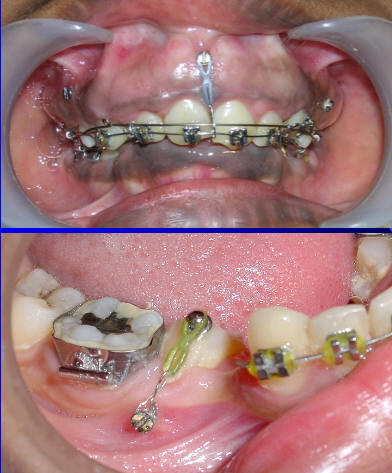
    Best location for screw placement is in Maxilla between II pm and first Max molar, and this is the place to start for the beginners. This is also the most needed point of force delivery as most our cases have class II type pattern. But after you gain experience you can place in other locations.

    #15617
    Anonymous

     Advantages of Microimplants

    Use of these devices leads to:

    • 24 X 7 Force delivery
    • simplified mechanics,
    • improved results,
    • drastic reduction (upto 40%) in treatment timing,
    • reduction in number of extractions
    • Minimal dependence on patient co operation

    Disadvantages of Microimplants

    • High Cost of the devices
    • Failure of about 10% fixures
    • Problem in site selection in patients with poor Bone quality
    • Patient acceptance may be an issue in some cultures

    Common Indications for placement of Temporary Anchorage devices/mini implants

    Every case is not suited for microimplants. Minimal anchorage cases now can be treated non extraction with MI, many other average extraction cases we found that treatment objectives are achieved and extraction space is still remaining. Hence the cases where you need molars to come forward to occupy some of the ext space, are better done without MI or done with caution.

    1. Mini implants are used most beneficially where three dimensional stable anchorage is needed, some of these situations are: 
    2. Where you can not afford any movement of reactive units (maximum anchorage case)
    3. Patient with several missing teeth making it difficult to engage posterior units
    4. For difficult tooth movements, eg intrusion of anterior and posterior segments and ditalisation
    5. Where asymmetrical tooth movement is needed
    6. To treat borderline cases with non extraction method
    7. Doing extreme ortho when patient is not willing to undergo orthognathic surgery

    Common SITES OF PLACEMENT-see pic below

    MAXILLA: 

    • Infrazygomatic crest area.
    • Tuberosity area.
    • Between 1st and 2nd molars buccally.
    • Between 1st molar and 2nd premolar buccally.
    • Between canine and premolar buccally.
    • Between incisors facially.
    • Mid palatal Area.

    MANDIBLE:

    • Retromolar Area.
    • Between 1st and 2nd molars buccally.
    • Between 1st molar and 2nd premolar buccally.
    • Between canine and premolar buccally.

Viewing 2 posts - 1 through 2 (of 2 total)
  • You must be logged in to reply to this topic.